
This release continues the ongoing trend of applying Copilot AI agents within financial processes. With the introduction of MCP server technology within Copilot, we are seeing a wide range of new use cases emerge for repetitive, analytical, and timeconsuming tasks. Examples include applications within accounting activities, as well as agents that help accelerate period closings and provide faster insights into business performance. We would be happy to discuss how these capabilities could also be applied within your organization. In addition to broad investments in AI, Microsoft is further expanding capabilities in financial reporting and supporting the financial planning process (FP&A). Within the core finance processes, many improvements are being made, particularly to the major features that have been introduced in recent years. These include invoice capture, einvoicing, tax calculation, subscription billing, and finance AI agents. A major new announcement in this release is the new journal framework.
Business Performance Analytics (Reporting)
1. BPA data model extensions
The reporting tool Business Performance Analytics (BPA), integrated within the Dynamics platform, will be expanded with additional data models to support reporting. These extensions include:
- Acquire to Dispose data
- Manufacturing value chain data
In addition, BPA now offers options to connect with Power BI and Fabric data for custom model extensions.
2. BPA data refresh
Improvements are coming to the data refresh frequency, allowing for more frequent updates. Instead of the current maximum of twice per day, it will become possible to refresh data hourly.
This enables reporting based on much more recent information, significantly reducing the gap between ERP data and the reporting dataset. This is particularly useful during period closings, when last‑minute adjustments and postings need to become visible quickly.
Business Performance Planning (FP&A planning process tool)
1. Accelerated setup of the BPP data model
Setting up the data model for Business Performance Planning (BPP) previously required a significant amount of design and implementation effort. Microsoft has recognized this and will now offer quick‑start templates, enabling faster and simpler deployment of this product.
2. Using ERP data in the planning process
The use of ERP data within the planning process will also be simplified. By leveraging figures from your Dynamics 365 Finance environment, you can use actuals and apply them directly to future planning scenarios.
New capabilities within Dynamics 365 Finance
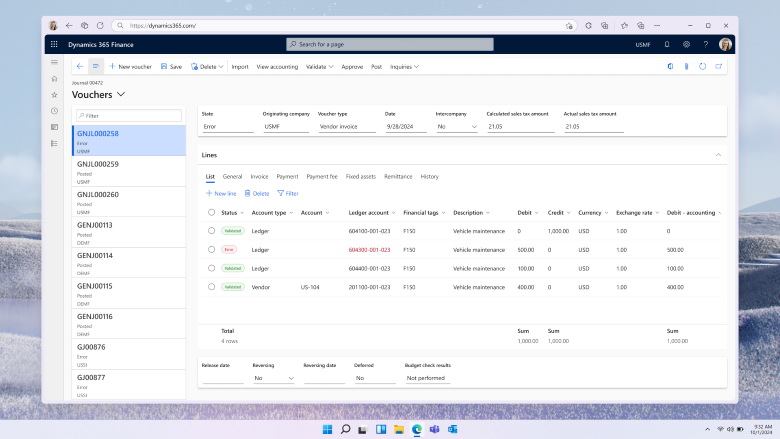
1. Completely redesigned journal framework
Microsoft will release a new financial journal framework, alongside the existing one.
Key benefits include:
- Improved import and processing performance, especially for large data volumes
- Multi company journal usage: it will become possible to post to multiple companies within a single journal
- This is particularly useful for scenarios such as payroll journal imports containing data for multiple companies, eliminating the need to split data into separate imports
- Error handling and posting at line level
- A completely new user interface
The new framework is expected to exist alongside the current journal functionality.
These are important improvements, as journals are heavily used and enhancements here can have a significant impact — especially on period closing processes.
2. Fixed Asset transfer/split
A new wizard‑based approach will be introduced to make it easier to transfer Fixed Assets to another legal entity. Through simulations, you can preview the financial impact of the processing. Improvements have also been announced for splitting Fixed Assets.
3. Tax Calculation – Registration ID’s extensions
Tax Calculation already allows you to manage multiple VAT registrations within a single Legal Entity—for example, a Dutch company with VAT obligations in another EU country.
With this extension, it will also become possible to register other legal business identifiers, such as Chamber of Commerce numbers or industry‑specific identifiers per VAT registration. This will be especially useful for scenarios such as e‑invoicing.
4. Finance Agent: Account Reconcilliation
The Account Reconciliation agent helps accelerate period closing by taking over a large portion of control activities. The agent proactively and regularly performs checks on your behalf.
Previously, these checks were limited to a small number of modules. In this release wave, they will be expanded to include the highly requested functionality of checking the inventory subledger.
Subsequently, coverage will be extended to: Fixed Assets, Project Accounting, Intercompany.

5. Invoice recognition within the Dynamics platform
Microsoft continues to invest heavily in facilitating purchase invoice recognition, with a strong focus on this part of the invoice process. Modern AI / LLM techniques will be applied even more extensively to further improve invoice recognition accuracy. User‑experience improvements are also planned.
6. New Dutch Tax Authority regulations applied (Auditfile)
The Dutch Tax Authority has established XAF 4.0 as the new standard for audit files.
Microsoft Dynamics 365 Finance will implement these changes as part of this release wave. Further details on the changes will be communicated separately.
What’s in it for you?
Controllers, Finance Managers, Accounting teams
For finance teams, this release is all about working smarter and improving control. Microsoft is making clear progress in supporting core financial processes with AI solutions, improved journals, and more extensive reporting.
This results in faster period closings, fewer manual checks, and more up‑to‑date insights during the closing process.
With extensions to Business Performance Analytics and FP&A, it becomes easier to translate current figures into reliable reports and forward‑looking scenarios. At the same time, improvements in compliance and audit support provide greater control and confidence in the financial administration—creating space to shift focus from execution to analysis and decision‑making.
Administrators
For IT and ERP owners, this release offers a robust and future‑proof foundation. The new journal framework and performance improvements contribute to a scalable and stable Dynamics 365 Finance environment, even as data volumes and complexity increase.
In addition, the extensions around AI agents, integrations with Power BI and Fabric, and support for new legislation and regulations (such as Auditfile XAF 4.0) align well with modern data and application architectures. This makes the platform easier to manage and better prepared for future developments.
Why act now?
This release wave demonstrates that Microsoft is making targeted investments in the continued evolution of Dynamics 365 Finance. AI support, faster financial processes, and more reliable management information come together in this release.
At the same time, key regulatory changes are incorporated immediately, preventing the need for reactive adjustments later on.
By pausing now to reflect on these developments, organizations gain the opportunity to make deliberate choices: Which innovations align with your ambitions and processes, and when do they fit on your roadmap? By reviewing this together in a timely manner, you avoid ad‑hoc changes and lay a solid foundation for further optimization.
We are happy to help assess the impact of this release on your organization and translate these possibilities into concrete, achievable next steps.
Written by

Wesley Legters
Finance Consultant Operations